SteadyVane
Daily brief · November 27, 2026

Hub is an open-source dispatcher that runs many Claude Code or Codex sessions for you

3 items that moved, with the numbers. Measured by SteadyVane, fact-checked, and graded before publishing.

Hub is an open-source dispatcher that runs many Claude Code or Codex sessions for you

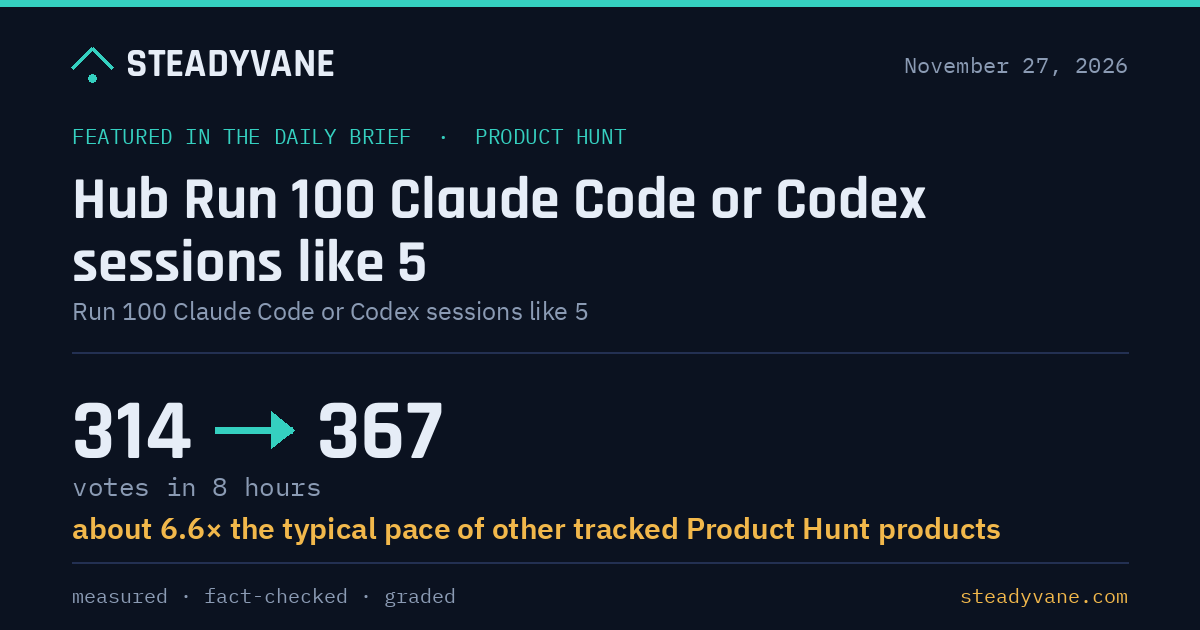
314 → 367votes on Product Hunt in 8 h · 169 commentsabout 6.6× the typical pace of other tracked Product Hunt products

Hub lets you write a goal in a browser or Telegram; a coordinator hands it to agents and only the decisions come back. It is self-hosted, Apache-2.0 licensed, free, and runs on your own Claude or ChatGPT subscription. Each session is a real Claude Code or Codex process.

Hub went from 314 to 367 votes on Product Hunt in 8 hours - about 6.6 times the typical pace of other products SteadyVane tracks on Product Hunt. It has 169 comments, about 20 hours after it was posted.

Why it matters: If you already pay for Claude or ChatGPT, this is a way to run more agent sessions in parallel without adding a vendor. The catch is in the project's own words: sessions run with permission prompts off, and the software is labelled experimental.

Fewer prompts is the pitch. It is also the risk.
OpenGame turns local coding agents like Claude Code and Codex into a game studio

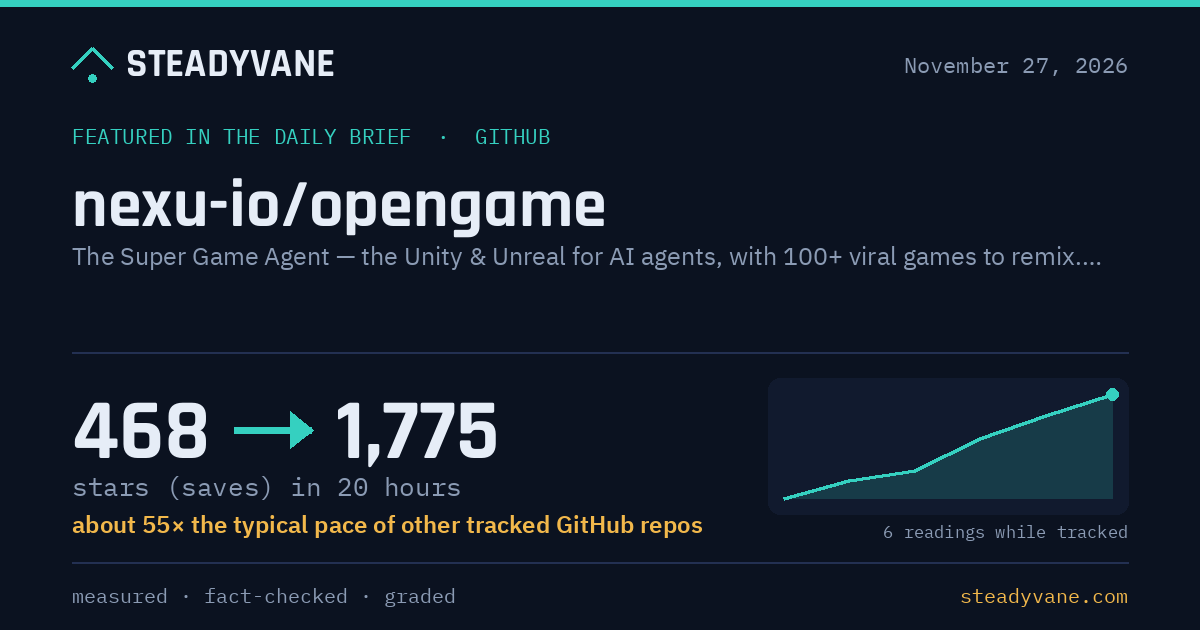
468 → 1,775stars (saves) on GitHub in 20 habout 55× the typical pace of other tracked GitHub repos

OpenGame is an open-source project from nexu-io that connects local coding agents such as Claude Code, Codex and DeepSeek to build and remix 3D and mini-games. Per its README, it works with 22 local agents and exposes 12 MCP game tools. Publishing to WeChat, Douyin, TikTok and itch.io comes as guided packaging scripts and checklists, alongside HTML5 exports.

The repo went from 468 to 1,775 stars (saves) on GitHub in 20 hours - about 55 times the typical pace of other repos SteadyVane tracks on GitHub. It has 294 forks, about 2.1 days after it was created.

Why it matters: It uses the coding agent you already have instead of a new editor, and the publishing support is checklists and scripts rather than one-click publishing. Worth a look if you want to see how far agents get on game work with real handbooks behind them.

A studio in a repo still needs someone with taste to say the game is not fun yet.

How to think about where an AI agent runs: four workloads, not one

36,999 → 45,871views of the video in 8 h · 83 commentsabout 7.1× the typical pace of other tracked AI-tool videos

An IBM Technology video presented by Legare Kerrison argues that an AI agent is not really one workload. It splits agent architecture into inference, orchestration, tool execution and persistent state, and covers how each changes deployment, scaling, security and reliability.

A video about it went from 36,999 to 45,871 views in 8 hours - about 7.1 times the typical pace of other AI-tool videos SteadyVane tracks on YouTube. It has 675 likes and 83 comments about a day after it was published.

Why it matters: If you are deciding where to host an agent, the useful question is which of the four pieces needs what, since each is described as affecting deployment, scaling, security and reliability differently. Treating it as one box hides those choices.

The agent is the demo. The state it has to remember is the deployment.

All briefs · What is rising now