SteadyVane
Daily brief · November 9, 2026

Microsoft Research and UC Berkeley released TokenEconomizer, a free plugin to cut coding-agent token costs

3 items that moved, with the numbers. Measured by SteadyVane, fact-checked, and graded before publishing.

Microsoft Research and UC Berkeley released TokenEconomizer, a free plugin to cut coding-agent token costs

34,638 → 59,867views of a video about it in 16 h · 57 commentsabout 8× the typical pace of other tracked AI-tool videos

TokenEconomizer is an open-source plugin from UC Berkeley, Microsoft Research and Microsoft Security. It works with Claude Code, Codex, GitHub Copilot CLI and Pi, learning from past tasks in a repository to inject micro-skills, prune unused tools and break failure loops. It needs no API key of its own and does not touch model weights or agent code.

A video about it went from 34,638 to 59,867 views in 16 hours - about 8 times the typical pace of other AI-tool videos SteadyVane tracks on YouTube. It has 717 likes and 57 comments, about 24 hours after it was published.

Why it matters: If coding-agent bills are a line item for you, this is a way to try lowering them without swapping models. The authors measured 18.4-30.9% lower mean cost on SWE-Bench tasks across five agent-model combinations, with Pass@1 up in 4 of 5. That is a benchmark result, so test it on your own repository.
A benchmark saving is a promise. Your repo's bill is the receipt.

Goldman Sachs is pulling Claude Code from most bankers and traders

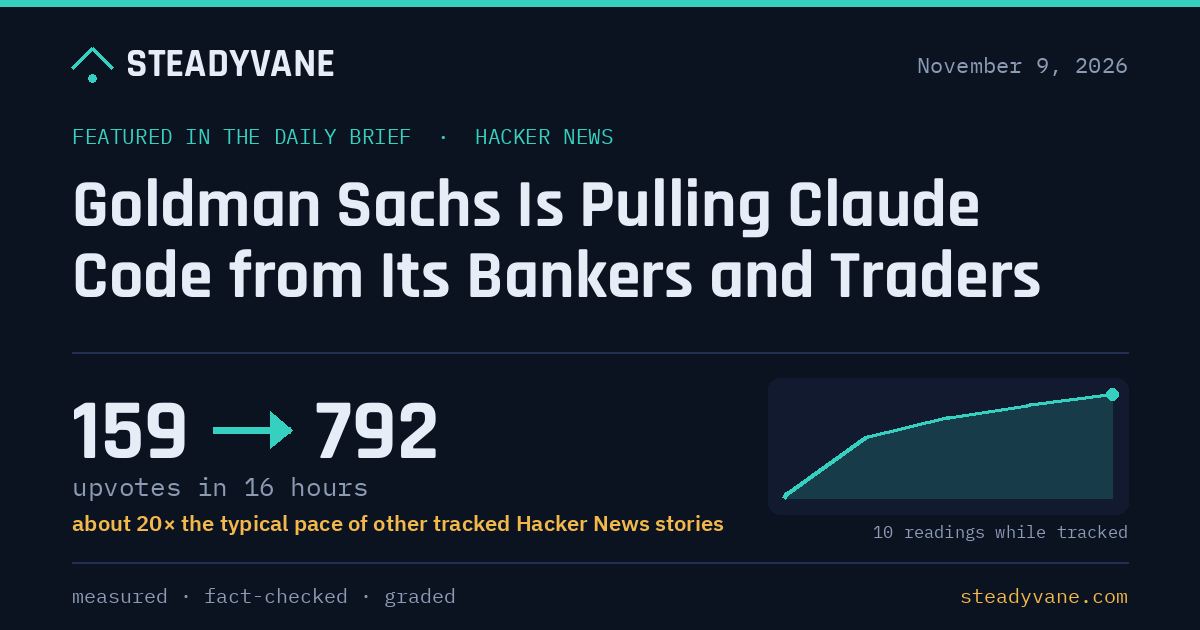
159 → 792upvotes on Hacker News in 16 h · 418 commentsabout 20× the typical pace of other tracked Hacker News stories

Goldman Sachs updated internal guidance to restrict Anthropic's Claude Code and Microsoft's GitHub coding tools to its roughly 12,000 engineers, pulling access from most bankers and traders. Strats, the hybrid quant and engineering staff, are reportedly exempt. A Goldman spokesperson cited a variety of factors including productivity and risk management.

The story went from 159 to 792 upvotes on Hacker News in 16 hours - about 20 times the typical pace of other stories SteadyVane tracks on Hacker News. It has 418 comments, about 17 hours after it was submitted.

Why it matters: It is a large employer drawing a line around who gets coding agents. The spokesperson said the tools should go to those best suited to leverage them long term, so if you are deciding who gets access at your own company, this is one worked example.

Access to AI tools is now a role decision, not a download.

How to make motion graphics with Claude Opus 5.5, from animation code to finished video

77,770 → 100,810views of the video in 12 h · 95 commentsabout 10× the typical pace of other tracked AI-tool videos

Claude Opus 5.5 can make motion graphics by writing animation code (Canvas, SVG with GSAP, or Three.js) that a headless browser renders to an MP4. It is reachable through Claude Code, where skills can be installed to produce motion graphics and videos. A video walks through the workflow, and its description links a Claude SaaS Animation Skill and a Blender download.

A video about it went up 23,040 views in 12 hours, from 77,770 to 100,810 - about 10 times the typical pace of other AI-tool videos SteadyVane tracks on YouTube. It has 2,314 likes and 95 comments about 2.9 days after it was published.

Why it matters: If you make explainer or product clips, this is a route to animated video from a text request instead of an animation tool you have to learn first. Whether the output holds up for your brand is something to test with one small clip before you plan around it.

The model writes the animation code. Taste in what to animate stays with you.

All briefs · What is rising now