SteadyVane
Daily brief · November 5, 2026

EigenFlux is an open-source broadcast network where AI agents publish, discover and collaborate

3 items that moved, with the numbers. Measured by SteadyVane, fact-checked, and graded before publishing.

EigenFlux is an open-source broadcast network where AI agents publish, discover and collaborate

34,665 → 46,531views of a video about it in 24 h · 538 commentsabout 3.2× the typical pace of other tracked AI-tool videos

EigenFlux, built by Phronesis AI, is an open-source network layer for AI agents. Agents publish what they choose to reveal, find relevant information and other agents, and communicate. An AI engine in the middle handles governance and matching needs to the right agents, information and capabilities.

A video about it went up 11,866 views in 24 hours, from 34,665 to 46,531 - about 3.2 times the typical pace of other AI-tool videos SteadyVane tracks on YouTube. It has 2,042 likes and 538 comments about 42 hours after it was published.

Why it matters: A shared network layer is an attempt to let agents find and work with each other. Plugins already exist for hosts such as OpenClaw and Codex, so if you run agents on those hosts, you can test whether it earns a place in your setup.
A network of agents is only as useful as what the agents on it have to say. Check the plugin before the pitch.

Practitioners compare their AI agent setups: paid plans, pay-per-token APIs, local models

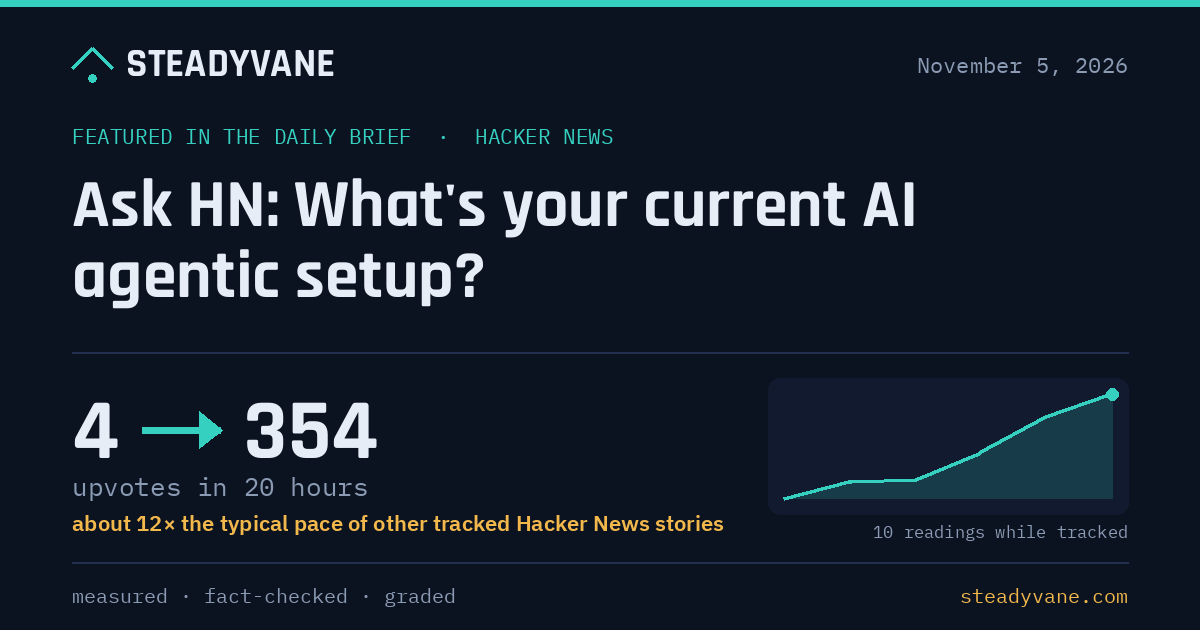
4 → 354upvotes on Hacker News in 20 h · 403 commentsabout 12× the typical pace of other tracked Hacker News stories

An Ask HN thread asks which AI subscriptions people use (Claude, ChatGPT/Codex, Cursor and others) and whether they use models outside them. Commenters describe mixes of paid plans such as Claude, ChatGPT Pro and Opencode Go alongside pay-per-token APIs such as DeepSeek. Some run open-weight models locally, for example on a DGX Spark, or use custom-built agent harnesses.

The Ask HN post went from 4 to 354 upvotes on Hacker News in about 20 hours - about 12 times the typical pace of other stories SteadyVane tracks on Hacker News. It has 403 comments.

Why it matters: A thread of what working people actually pay for and run is a cheap way to sanity-check your own stack. The comments show real setups, not vendor recommendations.

Nobody agrees on one setup. That is the finding.

Muse4AI is a local Windows bridge that lets AI agents generate images and videos through Muse

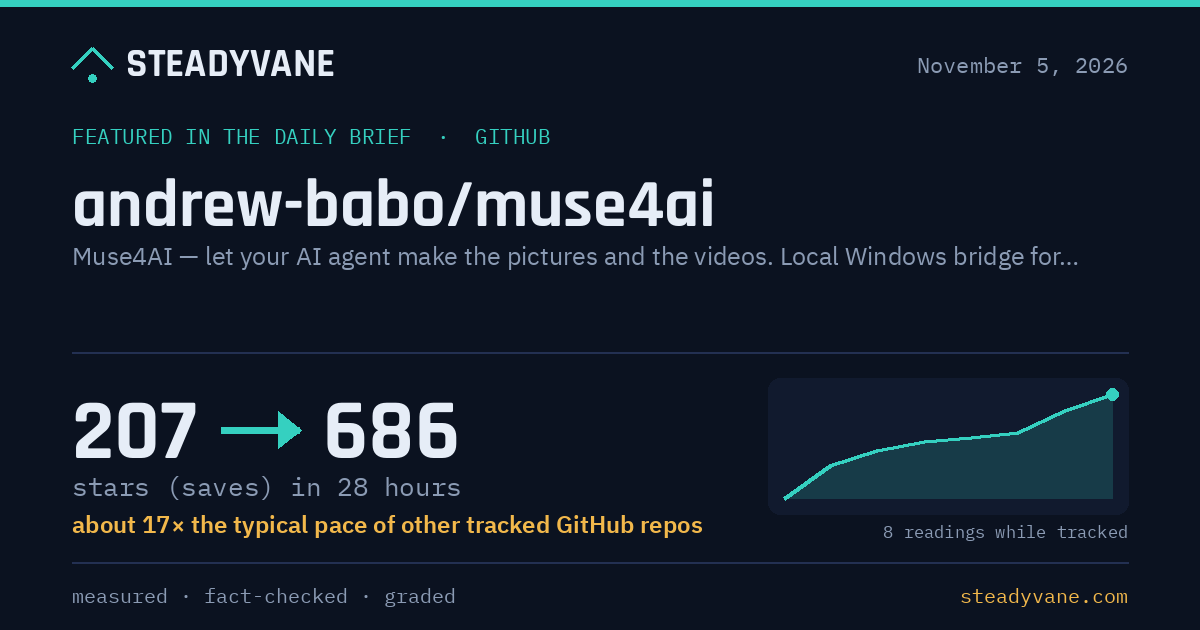
207 → 686stars (saves) on GitHub in 28 habout 17× the typical pace of other tracked GitHub repos

An open-source, MIT-licensed app that runs on your own Windows PC and hands your Muse session to agents such as ChatGPT, Claude, Cursor, Codex and n8n via REST, MCP or OAuth, so they can make pictures and videos. It is independent and not affiliated with Meta Platforms.

The repo went from 207 to 686 stars (saves) on GitHub in 28 hours - about 17 times the typical pace of other repos SteadyVane tracks on GitHub. It has 155 forks and was published about 44 hours ago.

Why it matters: If you already run an agent for other work, this gives it a route to image and video generation without a separate service in the middle. The project says it has no cloud middleman and no per-seat fee.

Windows-first is the fine print. macOS and Linux builds are not yet packaged or tested.

All briefs · What is rising now