SteadyVane
Daily brief · October 24, 2026

Moonshot AI released Kimi K3.1 Pro and a Highspeed variant, with a 1-million-token context window

2 items that moved, with the numbers. Measured by SteadyVane, fact-checked, and graded before publishing.

Moonshot AI released Kimi K3.1 Pro and a Highspeed variant, with a 1-million-token context window

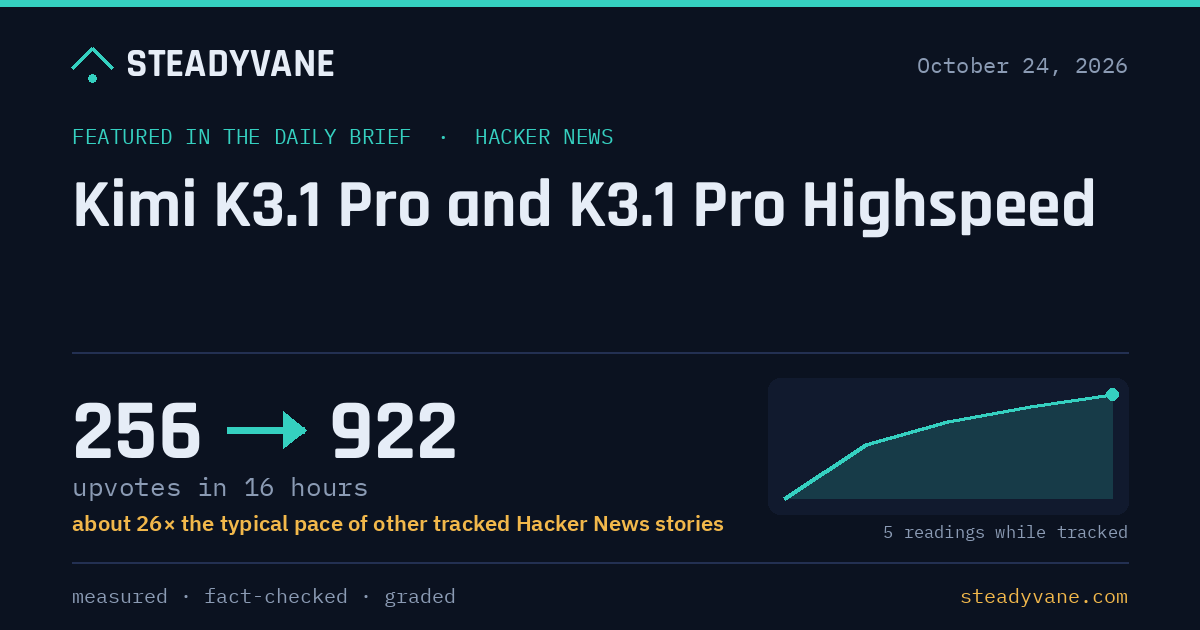
256 → 922upvotes on Hacker News in 16 h · 542 commentsabout 26× the typical pace of other tracked Hacker News stories

Kimi K3.1 Pro is the first model in Moonshot's K3.1 series, described as its most capable 3T-class open-weight model to date. Kimi K3.1 Pro Highspeed is a variant that delivers 2-3x the speed of K3.1 Pro.

The announcement went from 256 to 922 upvotes on Hacker News in 16 hours - about 26 times the typical pace of other stories SteadyVane tracks on Hacker News. It has 542 comments and was submitted about 20 hours ago.

Why it matters: If you run long documents or large codebases through a model, a 1-million-token context window and a faster tier are worth a look. The listed prices are $2 per million input tokens and $10 per million output tokens for K3.1 Pro, and $4 and $20 for Highspeed. API access opens after a top-up of at least $1.

Faster costs double. Whether that is worth it for your task is a spreadsheet question, not a benchmark one.

A video makes the case for Obsidian as an AI backend rather than a second brain

34,492 → 143,034views of the video in 28 h · 145 commentsabout 19× the typical pace of other tracked AI-tool videos

A video from the Easy Machine AI channel says its creator's whole day runs on Obsidian: plain markdown files, no database, no cloud, with scripts filling in numbers each morning. That description is the creator's claim, and SteadyVane could not confirm it.

The video went from 34,492 to 143,034 views in 28 hours - about 19 times the typical pace of other AI-tool videos SteadyVane tracks on YouTube. It has 2,182 likes and 145 comments.

Why it matters: The underlying idea holds up. Obsidian keeps notes as plain Markdown files in a local folder, so agents like Claude Code can read and write them directly, and scripts can use the Obsidian CLI or the Local REST API.

Plain files are an easy surface for an agent to read and write. Whether the video's full setup works as described is a separate question.

All briefs · What is rising now